How it works
An anger journal app that takes three minutes a day
Kettle is an anger journal app for iPhone. Once a day you answer five questions about what frustrated you, by typing or by talking, and it takes about three minutes. Over a few weeks the app charts your frustration and stress so you can see your own patterns.
Coming soon to iPhone
The five questions you answer each day
Every entry is the same five questions, in the same order. They’re written in the first person because you’re the one asking.
| Question | The hint under it | What you enter |
|---|---|---|
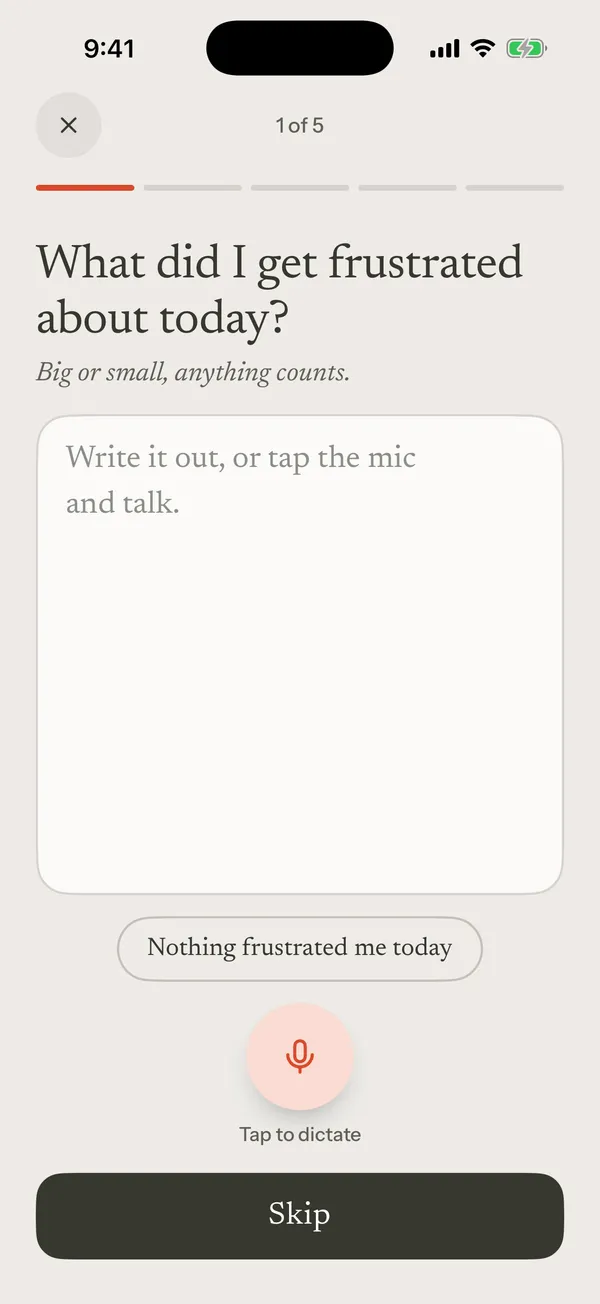
| 1 What did I get frustrated about today? | Big or small, anything counts. | A few words or a few sentences |
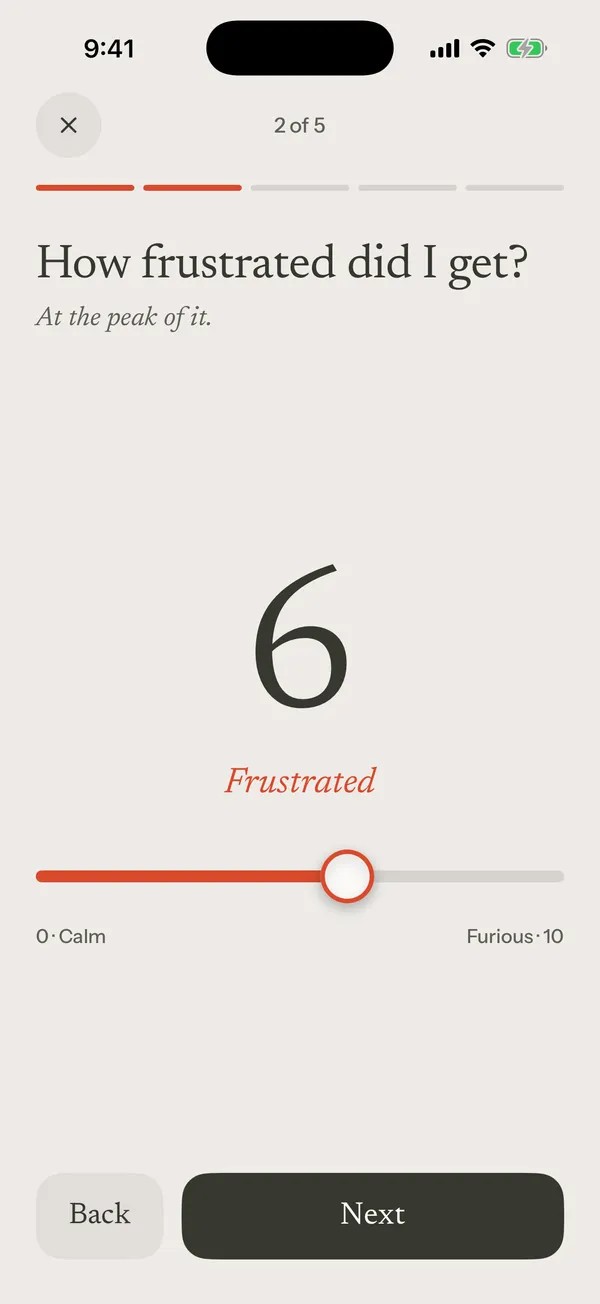
| 2 How frustrated did I get? | At the peak of it. | A number from 0 (calm) to 10 (furious) |
| 3 What else was going on? | Sleep, hunger, work, people, plans. | A few words or a few sentences |
| 4 What about the circumstances upset or frustrated me? | What did I expect that didn’t happen? | A few words or a few sentences |
| 5 How stressed am I in general today? | Not the moment, the whole day. | A number from 0 (relaxed) to 10 (overwhelmed) |
The first two questions capture the moment itself. The next two look around it: what else was going on that day, and what you expected to happen that didn’t. The last one is about the whole day, because a bad moment and a bad day aren’t the same thing.
The two numbers are what make the charts possible. The words are what you’ll want to read back later.
What does a finished entry look like?
Here’s one from the sample journal that ships with the app’s demo. It isn’t a real person’s entry.
- What did I get frustrated about today? “A client moved a deadline up by a week with no warning.”
- How frustrated did I get? 6 out of 10, which Kettle labels “Frustrated”.
- What else was going on? “Slept badly. Skipped lunch.”
- What about the circumstances upset or frustrated me? “It felt like my time didn’t matter to them.”
- How stressed am I in general today? 5 out of 10.
One entry like that doesn’t tell you much. Twenty of them might show that the bad days tend to follow bad nights, or that one kind of situation keeps coming up.
Type it, or talk
Each written question has a mic button. Tap it and talk, and your words appear as text. The dictation runs on your iPhone, so what you say isn’t sent anywhere.
Saved entries can’t be edited, so take the time you need before you save.
What if nothing frustrated me today?
Tap “Nothing frustrated me today”. Kettle records a 0, skips ahead to the stress question, and your streak carries on. Calm days belong in the picture too.
Streaks, and one reminder a day at most
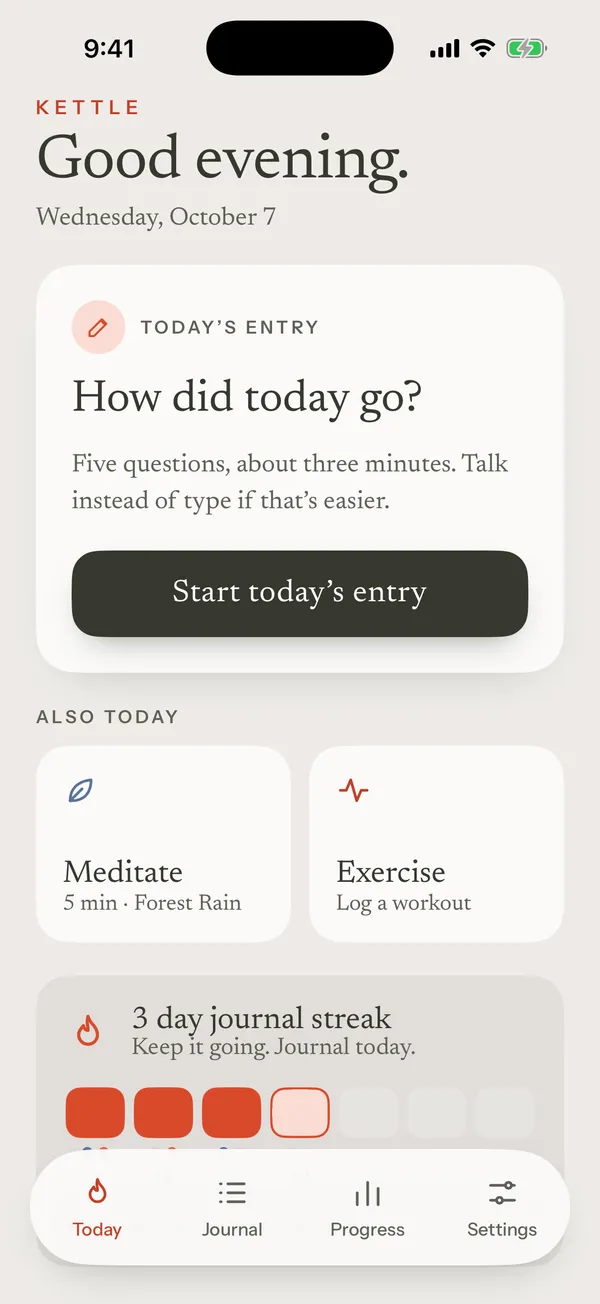
A streak counts the days in a row you’ve written an entry. Today shows it as a week of squares, one per day. If numbers like that make you feel worse, you can turn streaks off in Settings.
Reminders are optional. Turn the journal reminder on and Kettle sends one notification a day at the time you pick, and skips it on days you’ve already written. It never shows anything from your journal. Meditation and exercise have their own reminders, which stay off unless you want them.
There are two Home Screen widgets as well, one for your streak and one for this week.
Cool down
Two optional cool-down habits: meditation and workouts
After you save an entry, Kettle offers two ways to cool down. You don’t have to use either one, and you can turn each off in Settings so it disappears from the app.
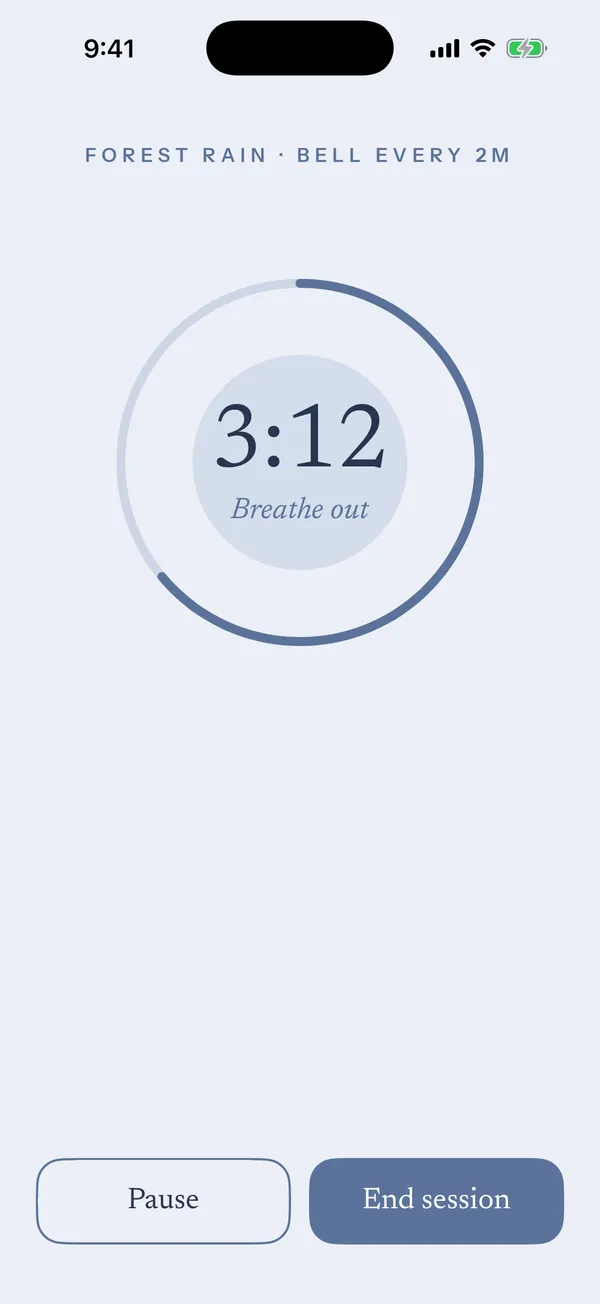
- A meditation timer for 5, 10, 15 or 20 minutes, with an optional interval bell and a background sound. A circle on screen grows and shrinks to pace your breathing. Afterwards it asks how you feel now: calmer, about the same, or still wound up.
- A workout log. You pick what you did (walk, run, ride, lift, yoga or something else), how long it took and how hard it felt.
Which one does the research support?
Kettle offers both, but the evidence behind them isn’t equal. A 2024 review of 154 studies found that calming activities such as deep breathing, mindfulness and meditation reduced anger and aggression. Activities that raise your heart rate, such as jogging, made no reliable difference overall, and the reviewers concluded that going for a run isn’t an effective way to manage anger.
So the timer is the cool-down with research behind it. The workout log is a record, there so you can see how your active days and your calmer days line up.
Progress: your frustration and stress over time
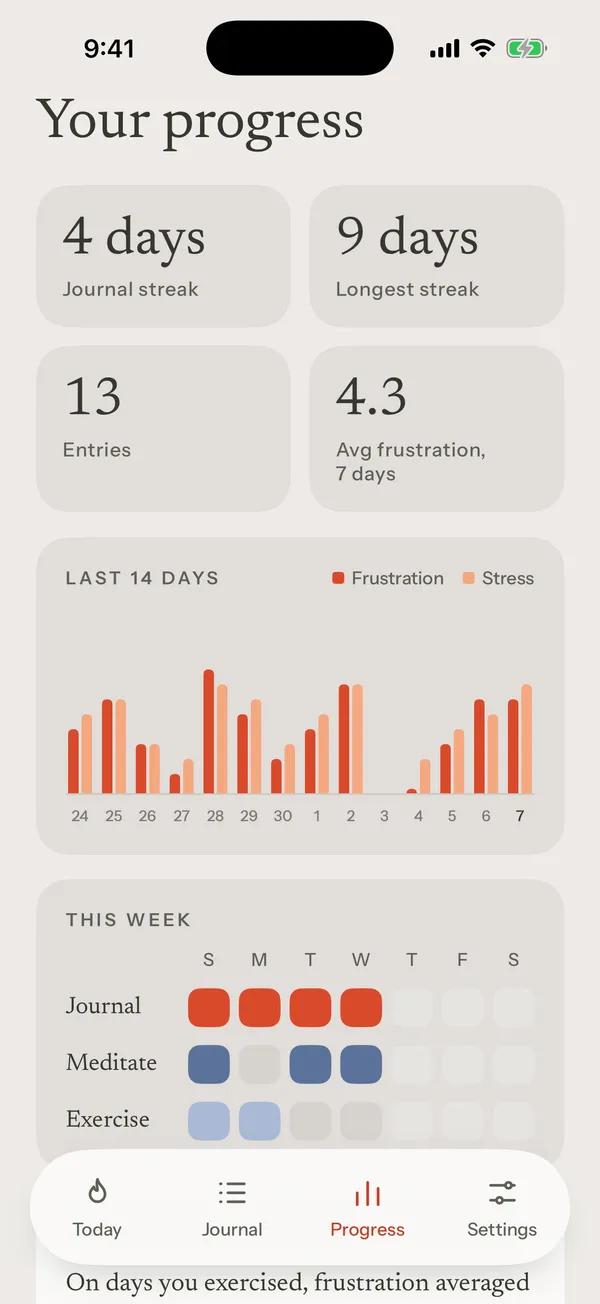
The Progress tab shows your current streak, your longest streak, how many entries you’ve written and your average frustration over the last seven days.
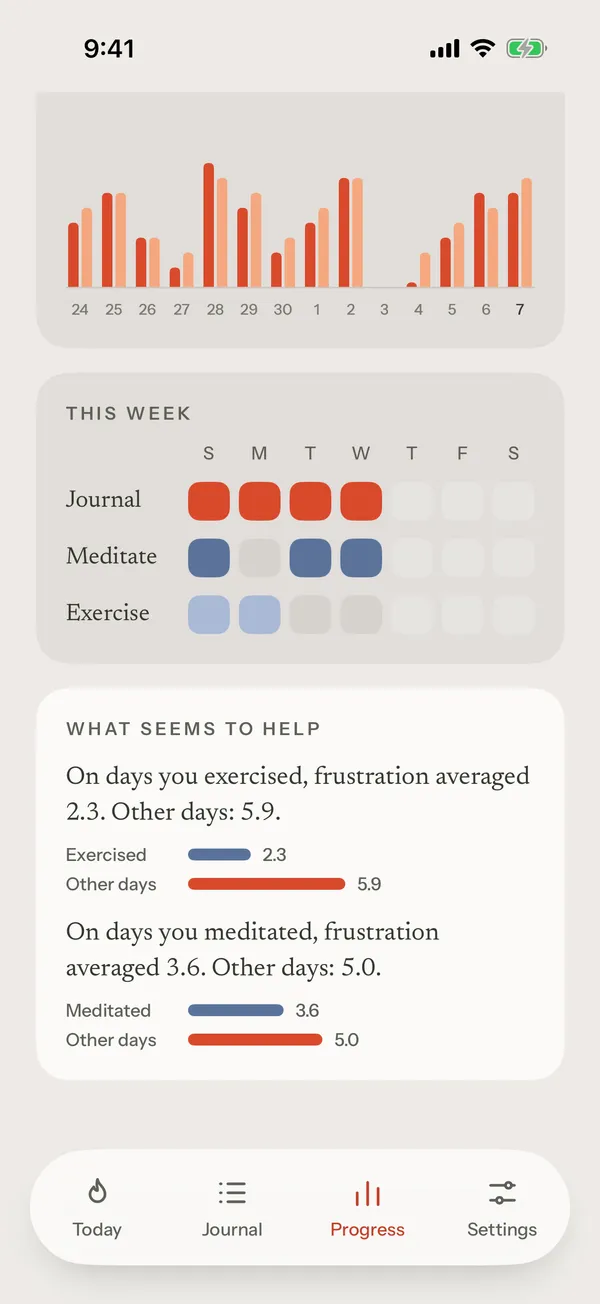
Under that is a chart of the last 14 days, with a bar for frustration and a bar for stress on each day, and a grid of this week’s journal entries, meditations and workouts.
What seems to help, and why it proves nothing
Once you have at least three days with a habit and three without, Kettle compares them. It might say: “On days you exercised, frustration averaged 2.3. Other days: 5.9.” This is part of Kettle Plus.
That’s a pattern in your own entries, and it’s worth noticing. It isn’t proof of anything. You might exercise more on days that were already going well.
More questions about Kettle
Does Kettle send my data anywhere?
Kettle doesn’t store any of your data outside your phone.
- There’s no account to create and no sign-in.
- Your journal is stored on your iPhone. Kettle has no server to send it to.
- Dictation happens on the phone.
- Notifications never show what you wrote.
- You can lock the app with Face ID.
The privacy policy has the detail.
What doesn’t Kettle do?
- It doesn’t use AI. Nothing reads or analyses what you write.
- It doesn’t diagnose anything, and it isn’t treatment.
- It doesn’t let you edit an entry after you save it.
- It doesn’t offer guided meditation. The timer is a timer, with a sound and a breathing circle. If you want a voice talking you through it, a dedicated meditation app such as Headspace is a better fit.
- It doesn’t run on iPad or Android, and it needs iOS 18 or later.
- It’s in English only.
What’s free, and what does Kettle Plus add?
The journal is free for good, along with reminders, streaks, widgets, Face ID lock, the 14-day chart, the meditation timer and the workout log. Kettle Plus adds “What seems to help”, your journal history beyond the last 30 days, two more sounds, two more bell intervals and the meditation timer on your Lock Screen.
Plus is one yearly subscription at $14.99, $24.99 or $49.99, and every price unlocks the same thing. If you can’t pay right now, you can choose that in the app and get the same Plus. Pricing explains how it works.
Who makes Kettle?
I do. I’m Andrew Askins. I’ve struggled with my anger for most of my life, and it has affected my relationships at home and at work. I’m not a clinician. More about me and why Kettle exists.
Who is Kettle for, and when is a professional the better choice?
Kettle is for adults who get angry or irritable more often than they’d like and want to understand why. If you like the idea of a few quiet minutes at the end of the day and a chart that fills in over time, it will probably suit you.
Kettle is a journal, not a therapist. If anger is hurting you or the people around you, it’s worth talking to a professional. The Get help page lists where to start, including what to do if you need help right now.
When can I get Kettle?
Kettle isn’t on the App Store yet. It will be for iPhone only, and there’s no waiting list to join. In the meantime the guides and printable worksheets are free, with no sign-up. The daily anger log is the closest thing to Kettle on paper.
Coming soon to iPhone