Signs of anger issues: when anger becomes a problem
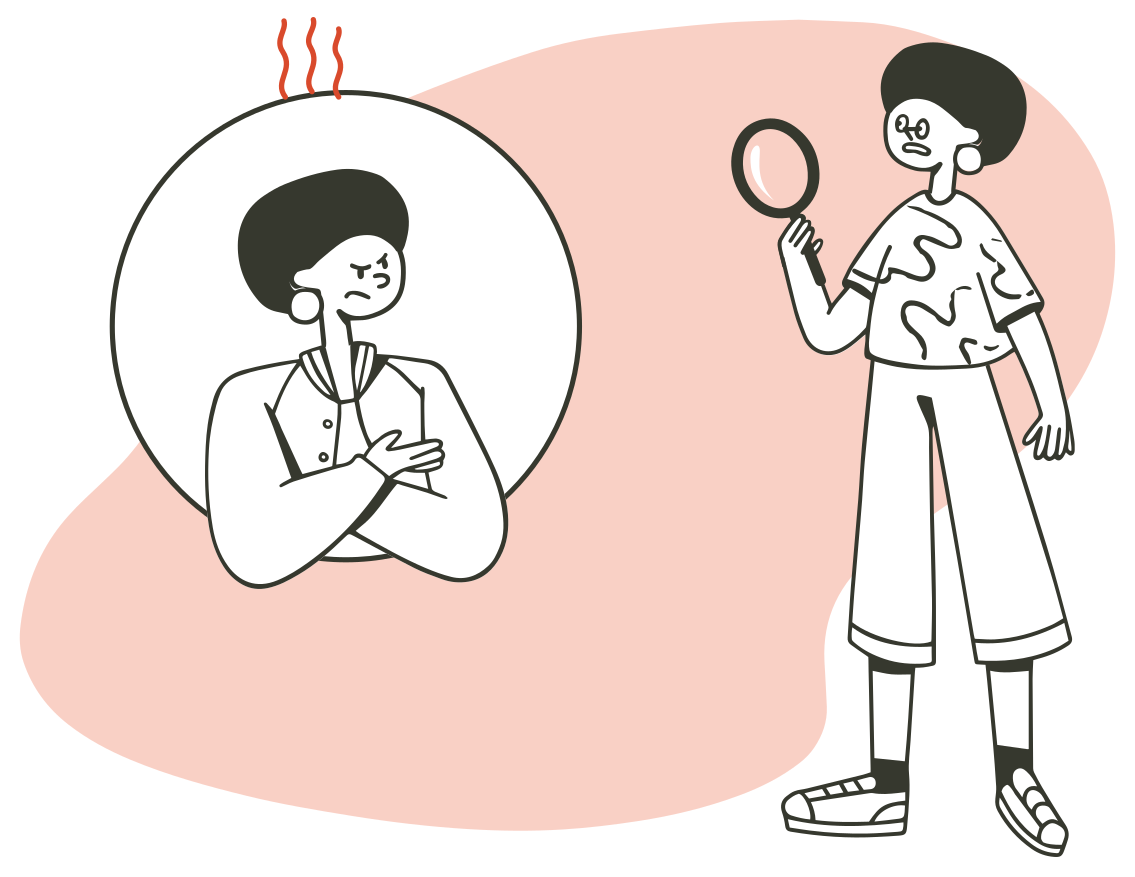
“Anger issues” is an everyday phrase, not a diagnosis. The American Psychological Association (APA) says uncontrolled anger “doesn’t have a name or an official diagnosis”. So the signs of anger issues are things to notice about your own anger, not a test you pass or fail. Expert bodies judge problem anger by how intense it gets, how often it comes, how much control you keep, and what it costs you and the people around you.
I’m Andrew. I make Kettle, a daily anger journal for iPhone, and I’ve struggled with managing my anger my whole life. I’m not a clinician, so this page has no quiz and no score. Only a professional can assess you.
If someone is in danger right now
If you or someone else is at risk of being hurt right now, call your local emergency number. The Get help page lists crisis lines.
What do experts look at instead of a diagnosis?
The APA’s guide to controlling anger calls anger “a completely normal, usually healthy, human emotion”. Health bodies describe the point where it becomes a problem in a few ways:
- How intense and how frequent it is. A treatment manual from SAMHSA, a US government health agency, says anger becomes a problem “when it is felt too intensely, is felt too frequently, or is expressed inappropriately”.
- How much control you have. Mayo Clinic says to seek help if your anger “seems out of control, causes you to do things you regret or hurts those around you”.
- How long it stays. The APA counts nursing a grudge among the signs that someone might need help.
- What it costs. The NHS frames the question as whether anger is affecting your life.
These are expert descriptions, not research findings, and none of them gives a cut-off.
Signs of anger in your body
When you get angry, your heart rate and blood pressure go up, and so do adrenaline and noradrenaline, according to the APA. The NHS lists a faster heartbeat, tense muscles, clenched fists, tightness in the chest and feeling hot.
Those describe anger in anyone. Neither source presents them as the mark of a problem, and SAMHSA’s manual treats similar sensations as cues that anger is building. All of this is description by health bodies, and the APA page cites no study for its account.
The anger thermometer is a printable 0 to 10 scale with room to write what you notice in your body at each level.
Signs of anger in how you act
The NHS lists shouting, ignoring people or sulking, starting fights, breaking things and self-harming as changes in behaviour that can come with anger.
Anger isn’t always loud. The APA says easily angered people “don’t always curse and throw things; sometimes they withdraw socially, sulk, or get physically ill”. Both are expert descriptions, with no line for how much is too much.
Anger turned inward
The NHS says some people hide their anger and may take it out on themselves. The APA says unexpressed anger can turn inward, or come out as passive-aggressive behaviour: “getting back at people indirectly, without telling them why”. If you’re hurting yourself, please talk to a professional. The Get help page has places to start.
The research here is indirect. The APA says anger turned inward “may cause hypertension, high blood pressure, or depression”, and cites no study for it. A 2017 meta-analysis of 43 papers found that suppressing emotion was associated with poorer social wellbeing. It covered emotion in general, this page relies on its abstract, and an association can’t show cause. The same analysis found that expressing anger was also associated with poorer social wellbeing, so it doesn’t support exploding as the fix.
What anger costs in relationships and at work
In a US survey of more than 34,000 adults, 7.8% reported inappropriate, intense or poorly controlled anger. The authors describe it as anger that interferes with work, school or social relations, and it was associated with decreased psychosocial functioning. That was self-reported anger over a lifetime, the interviews date from 2004 and 2005, and one survey can’t show which came first. It isn’t the rate of any diagnosis.
In a study across 16 countries, 39% of people who met its definition of intermittent explosive disorder in the past 12 months reported severe impairment in at least one area of life, most commonly social or relationship functioning. That applies to people who met that definition, not to problem anger in general.
My own anger has affected my personal and professional relationships, which is why I built Kettle.
Anger and heart health
A 2009 meta-analysis of prospective studies found anger and hostility were associated with more coronary heart disease events in 25 studies of initially healthy people (combined hazard ratio 1.19, 95% confidence interval 1.05 to 1.35), and with a poorer prognosis in 19 studies of people with existing coronary heart disease (hazard ratio 1.24, 95% CI 1.08 to 1.42). Those are modest relative increases of 19% and 24%. The studies were observational, so they show an association and can’t show cause, and the authors reported indications of publication bias. This page relies on the abstract.
A 2014 systematic review measured something different. Its studies interviewed people after a heart attack or a similar event, and compared the two hours after an outburst of anger with other times. From four studies, it found a 4.74 times higher risk of heart attack or acute coronary syndrome in those two hours than at other times (95% CI 2.50 to 8.99). Results varied so much between studies (an I² of 92.5%) that the authors cautioned the combined estimate may not be meaningful.
The authors say the effect on any one person’s absolute risk is small when outbursts are rare, and higher for people who have frequent outbursts or who are already at higher risk. For one episode of anger a month, they estimated one excess cardiovascular event per 10,000 people per year at low (5%) 10-year cardiovascular risk, and four per 10,000 at high (20%) risk.
What intermittent explosive disorder is
Intermittent explosive disorder, or IED, is a diagnosis in the American Psychiatric Association’s Diagnostic and Statistical Manual of Mental Disorders. The association’s patient page describes recurrent outbursts that are impulsive and anger based and aren’t planned. They come on rapidly after a provocation, are out of proportion to it, and must be associated with distress or with social or occupational problems. Cleveland Clinic describes the aggression as greatly out of proportion to the situation.
Both pages are summaries for patients and not the manual’s own wording, and I’ve left out the numbers they give for how often and how long. Counting your own outbursts against a summary isn’t an assessment. Cleveland Clinic says IED is diagnosed by a licensed mental health professional. Mayo Clinic’s advice, if you recognise your own behaviour in a description of it, is to talk with a doctor or other health care professional.
Estimates of how common IED is vary widely with the definition used. A US survey of 9,282 adults put lifetime prevalence at 7.3% under a broad definition, using interviews that weren’t clinically validated. The 16-country study, with 88,063 adults and a conservative definition, found a weighted lifetime average of 0.8%. Both used an older edition of the manual, DSM-IV.
Signs of anger issues in a man or in a woman
The research on men and women is mixed. A 2004 meta-analysis found no sex difference in anger, and read the overall pattern as males’ greater use of “costly methods of aggression”. It included children as well as adults, and this page relies on its abstract.
The US anger survey reported somewhat higher odds of problem anger in men (odds ratio 1.21, 95% CI 1.11 to 1.32), though its measure included hitting people and throwing objects, so it partly captures aggression.
On how anger is expressed, the only source here is weak: an APA magazine article from 2003 that reports one researcher’s survey of 1,300 people. Total anger scores didn’t differ significantly, but men scored higher on physical and passive aggression, and women were found to be angry longer, more resentful and less likely to express it. None of the sources on this page lists different signs for men and women.
Anger questionnaires are tools for professionals
The APA mentions psychological tests that measure the intensity of angry feelings, how prone to anger you are and how well you handle it. One such test, the STAXI-2, is restricted to buyers who meet its publisher’s qualification level: a degree in psychology or a closely related field plus coursework in areas such as test interpretation, or a licence or certification from a body that requires training in the use of psychological tests. I haven’t reproduced any of these tests here.
When to talk to a professional about your anger
The NHS says to see a GP if you’re struggling to cope with anger and what you’re doing to help yourself isn’t working, or if you’re acting in an abusive or violent way. The APA suggests counselling if your anger feels out of control and is affecting your relationships and important parts of your life. It also says you might need help if you find yourself acting in ways that seem out of control and frightening.
A GP may be able to refer you to a local anger management programme or counselling, the NHS says. The APA’s advice is to look for a trained mental health professional with experience treating anger.
The Get help page covers how to find a therapist or programme, when to see a doctor first, and what to do if you’re worried you might hurt your partner or someone in your family.
If you’d like notes to bring to an appointment, the daily anger log is one printable page per day. For why the anger is there in the first place, read Why am I so angry?.
References
- Understanding anger: How psychologists help with anger problems.
- Control anger before it controls you.
- Anger Management for Substance Use Disorder and Mental Health Clients: A Cognitive–Behavioral Therapy Manual.
- Anger management: 10 tips to tame your temper.
- Get help with anger.
- Suppression and expression of emotion in social and interpersonal outcomes: A meta-analysis.
- Prevalence and correlates of anger in the community: results from a national survey.
- The cross-national epidemiology of DSM-IV intermittent explosive disorder.
- The association of anger and hostility with future coronary heart disease: a meta-analytic review of prospective evidence.
- Outbursts of anger as a trigger of acute cardiovascular events: a systematic review and meta-analysis.
- What are Disruptive, Impulse Control and Conduct Disorders?.
- Intermittent Explosive Disorder: Symptoms & Treatment.
- The prevalence and correlates of DSM-IV intermittent explosive disorder in the National Comorbidity Survey Replication.
- Intermittent explosive disorder: Symptoms and causes.
- Sex Differences in Aggression in Real-World Settings: A Meta-Analytic Review.
- Anger across the gender divide.
- State-Trait Anger Expression Inventory 2 (STAXI-2).
- FAQ Product Information (qualification levels).
Kettle
Kettle is a daily anger journal for iPhone. Five questions, about three minutes, and nothing leaves your phone.
Coming soon to iPhone